Leading in the Age of AI and Quantum: Challenges and Imperatives for Cybersecurity
5 min read
The technological frontier is advancing faster than many organizations are prepared for. Artificial Intelligence (AI) and Quantum Computing are no longer distant innovations: they are reshaping how we think about security, risk, and governance today. In Inside Cyber: How AI, 5G, IoT, and Quantum Computing Will Transform Privacy and Our Security, I explored the dual-edged nature of this transformation: opportunity abounds, but so do vulnerabilities. Now, in 2025, investment and innovation confirm the urgency of translating insight into action.
The Surge in Investment: What the Data Shows
Recent data indicates that the world is putting its money where its predictions have been.
McKinsey’s Quantum Technology Monitor 2025 estimates that quantum computing alone could generate between $28 billion and $72 billion in revenue by 2035, contributing to a broader quantum technology market—computing, communication, and sensing—pegged around $97 billion by then. McKinsey & Company
Private investment in quantum companies has already jumped significantly: in Q1 of 2025, quantum tech firms raised about $1.25 billion, nearly double what was raised in Q1 2024. The Quantum Insider+1
On the AI front, global AI-related investment continues to swell. Reports show that, as of mid-2025, venture funding and corporate investment into AI ecosystems are on track to surpass $300-$320 billion, with large rounds and infrastructure spending (data centers, specialized hardware) being major drivers. Konceptual AI+1
These figures show that what was once speculative is now mission-critical in both commercial and national security strategies.
Lessons from Inside Cyber and Earlier Writings
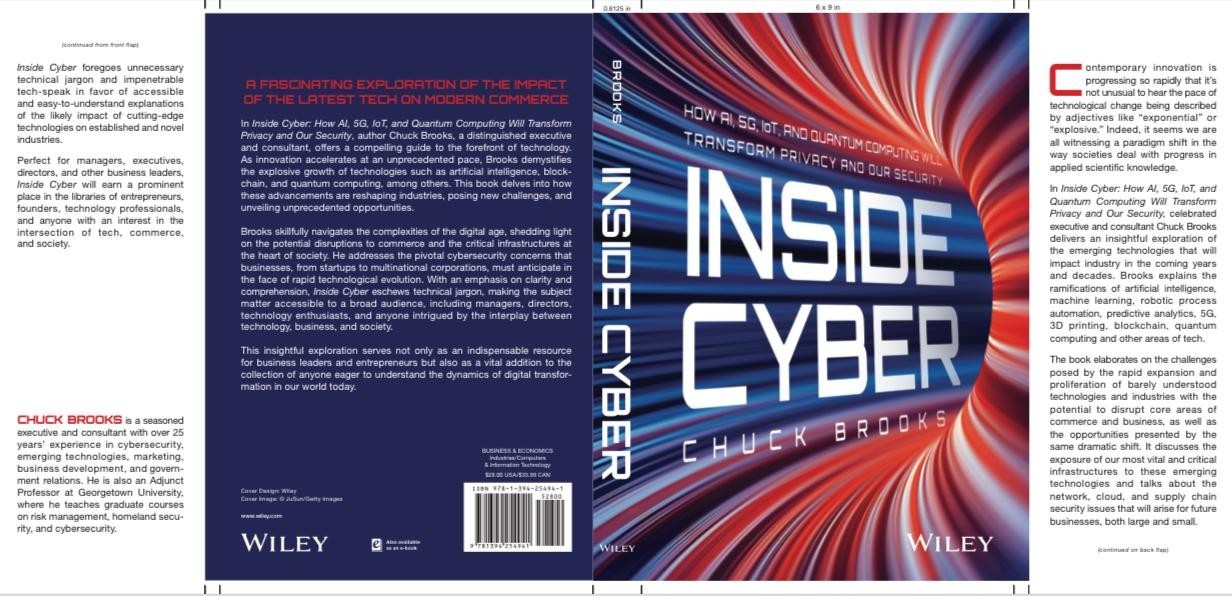
My book "Inside Cyber" available on Amazon
Drawing on my Inside Cyber book and other published essays, there are several recurring themes that remain highly relevant in this moment:
Technology is multipurpose. In Inside Cyber, I stress that technologies like AI and quantum are enablers in many arenas—not just for computational power, but for encryption, communication, sensing, and more. This multiplicity means that failures in one area (e.g., cryptography) ripple into many others (e.g., secure communication, digital identity).
The lag between research and deployment. Many quantum technologies exist in lab settings or limited pilot projects. One of my repeated concerns is the “valley” between proof of concept and field readiness—both for hardware stability and for software tools. As investments increase, that gap must shrink.
Security must be baked in, not bolted on. Whether we’re designing AI systems that make decisions or quantum systems whose encryption will guard secrets for decades, the architecture must anticipate misuse, adversarial attempts, and cryptographic evolution from the outset.
Global norms, trust, and governance are non-negotiable. Given quantum computing’s looming capacity to break today’s key encryption schemes and AI’s power to influence trust (through deepfakes, predictive profiling, etc.), I’ve emphasized that international frameworks around responsible AI, post-quantum cryptography, and secure supply chains are essential.
Key Cybersecurity Challenges in 2025
Given the current state of investment and the lessons we’ve long been talking about, several cybersecurity challenges have come into sharper focus:
Encryption fragility: Classical cryptosystems (RSA, ECC) are increasingly seen as risky in a future where quantum computers may undermine their hardness. Organizations still using those must plan transition paths now for post-quantum cryptography.
Model robustness and AI misuse: As large language models and autonomous agents proliferate, adversaries will continue to exploit model vulnerabilities—poisoned data, adversarial inputs, deepfakes, and impersonation. Trusted systems will depend on explainability, verifiability, and model governance.
Talent and infrastructure bottlenecks: Even as investment rises, there's a shortage of engineers, quantum algorithm designers, and cybersecurity experts familiar with these emerging techs. Meanwhile, infrastructure (quantum testbeds, quantum hardware, AI-friendly computing) lags, and delays in scaling or reliability can become security liabilities.
Supply chain and hardware risks: Quantum systems need highly specialized materials, precision engineering, and components with strong provenance. Weak links in manufacturing, firmware, or supply chain verification can introduce vulnerabilities that adversaries can exploit.
Regulation lag: Technology often moves faster than policy. Deepfakes, AI surveillance, quantum decryption threats are evolving without mature global norms, resulting in legal ambiguity, ethical challenges, and risk exposure.
Policy and Strategic Recommendations
From my years of writing and consulting, and from what Inside Cyber emphasizes, a set of policy and strategic actions stand out as essential if we are going to turn investment into secure advantage:
Mandate and support post-quantum cryptography: Governments and standards bodies should accelerate development, standardization, and adoption of quantum-resistant algorithms. Include requirements in critical infrastructure sectors now.
Regulate AI model governance: Require transparency, auditing, testing against adversarial attacks, and safe defaults. Encourage or mandate model verifiability, bias checks, and accountability for misuse, especially in deepfake-prone and mission-critical contexts.
Invest in dual-use infrastructure: Expand quantum testbeds, secure AI hardware, and trusted infrastructure labs. Public-private cooperation can help bridge the gap between research and deployment. Incentivize modular, resilient design.
Cultivate a skilled and diverse workforce: Education, apprenticeships, and cross-disciplinary training in AI, quantum, and cybersecurity are vital. Governments and industry must together invest in closing the gap between demand and supply of expert personnel.
Foster international cooperation and norms: Treat AI, quantum, and cybersecurity of them as global common goods. Encourage treaties or multilateral agreements on responsible AI, quantum safety, supply chain security, and data protection.
Support risk-based regulatory frameworks: Regulations should emphasize risk assessment, not checkbox compliance. Critical sectors should have policies that enforce risk modeling, threat detection, and incident response as core functions.

Looking Ahead: AI, Quantum, and the Road Ahead
Artificial intelligence and quantum computing are not just disruptive technologies—they are transformative forces that will define the digital era. Together they represent both the greatest leap in capability and the greatest shift in vulnerability that cybersecurity has ever faced. The future will be shaped not only by who innovates fastest, but by who secures most effectively.
If we treat AI and quantum as tools to strengthen resilience, enhance trust, and safeguard critical systems, they will accelerate human progress. If we neglect governance, foresight, and collaboration, they risk becoming accelerants of chaos. The choice is ours—but the window to act is narrowing.